Iguanodon
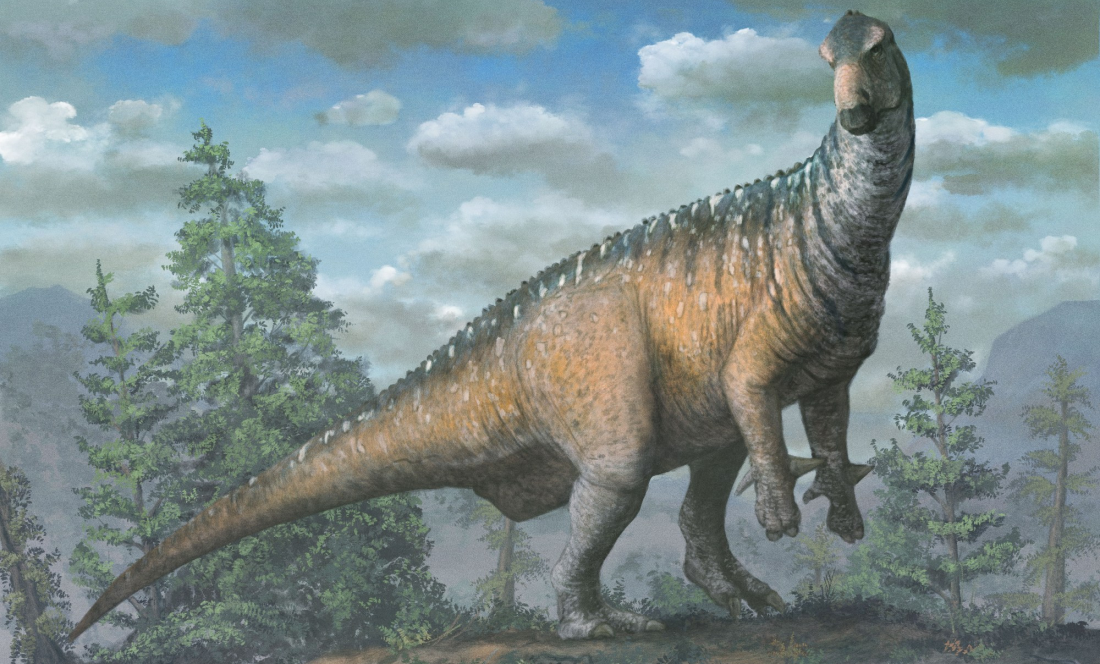
Name Meaning: "iguana tooth" / Location: Belgium, United Kingdom (England), Spain, Germany / Time Period: c. 125 million years ago (Early Cretaceous) / Length: 33 ft (10 m) / Weight: 5 tons (4,500 kg) / Locomotion: Quadruped & Biped / Diet: Herbivore / Described: 1825 (Mantell) / Geological Formation(s): Sainte-Barbe Clays, Camarillas, etc. / Valid Species: Iguanodon bernissartensis (type)
Phylogeny: Dinosauria > Ornithischia > Genasauria > Neornithischia > Cerapoda > Ornithopoda > Iguanodontia > Ankylopollexia > Styracosterna > Hadrosauriformes > Iguanodontidae
Overview: In the 1820's, an English physician by the name of Gideon Mantell came to possess a set of scattered fossils, clearly belonging to an enormous reptile. These consisted of teeth and some other bones. One of Mantell's associates pointed out similarities between the creature's teeth and those of modern iguanas, so when Mantell officially described the animal in 1825, it was named for this fact. In 1842, along with Megalosaurus and Hylaeosaurus, Iguanodon was one of the taxa used to establish the Dinosauria as a distinct clade. Early restorations depicted Iguanodon as a massively scaled-up iguana or, in some later depictions, as an elephant-like reptile walking on all fours. One bony spike associated with the find was interpreted as a large nasal horn. Decades later, in the 1870's, far more complete fossils were found deep within a Belgian coal mine, consisting of many complete skeletons. These were used as the basis for a new species - Iguanodon bernissartensis. One of these specimens was so complete that it was designated as the new type specimen for the genus Iguanodon.
The Belgian specimens revealed Iguanodon to be quite different than previously imagined. It was not an entirely quadrupedal animal, as it retained the ability to walk up on its hind limbs (bipedal locomotion being the ancestral state of ornithopods), though much of its time would've been spent down on all fours as it grazed. Like other iguanodonts, it possessed both a beak and a set of grinding teeth. Its supposed horn was actually a set of thumb-spikes, likely used for both foraging and defense against predators. Iguanodon possessed long and quite muscular arms, which in addition to its overall bulk, would've made it dangerous prey for most of the predators in its environment. Changing the type specimen of the genus to that of I. bernissartensis has caused a bit of an issue in recent years. It turns out that the genus described by Mantell and that from Belgium may not have been the same taxon, but as the type specimen was changed, the generic name of Iguanodon is now fixed to the latter. Mantell's specimens have since been referred to a new related genus called Mantellisaurus. Mantellisaurus may belong to the same iguanodontid family, though this is debated. Both animals were relatives of the famous “duck-billed” dinosaurs, though a fair bit more basal in comparison, retaining traits of their ancestors.